Sunday, May 14, 2006

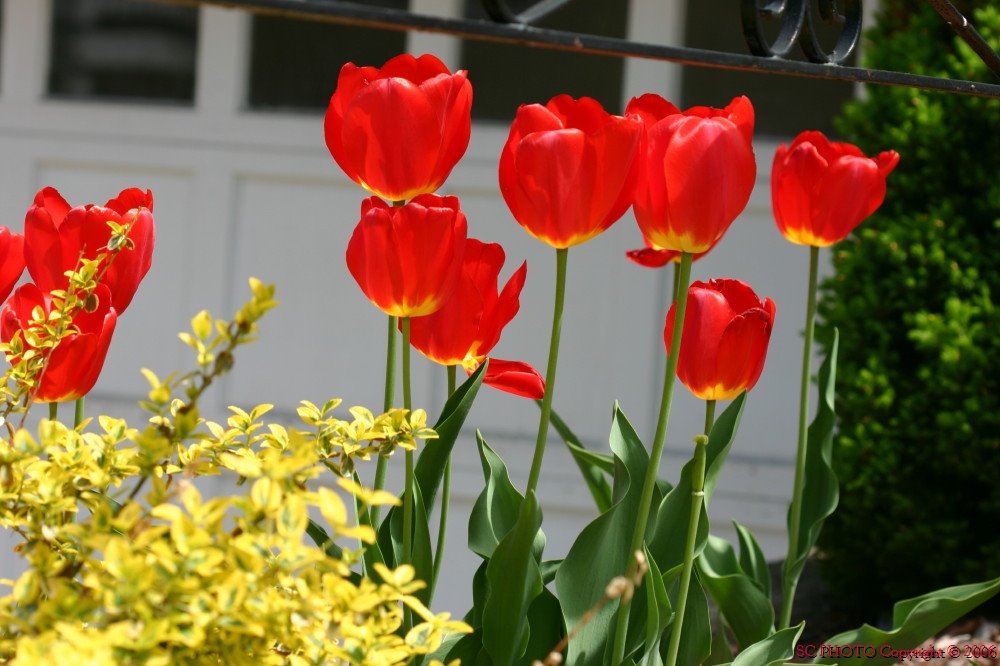
郁金香 Tulips in My Neighborhood

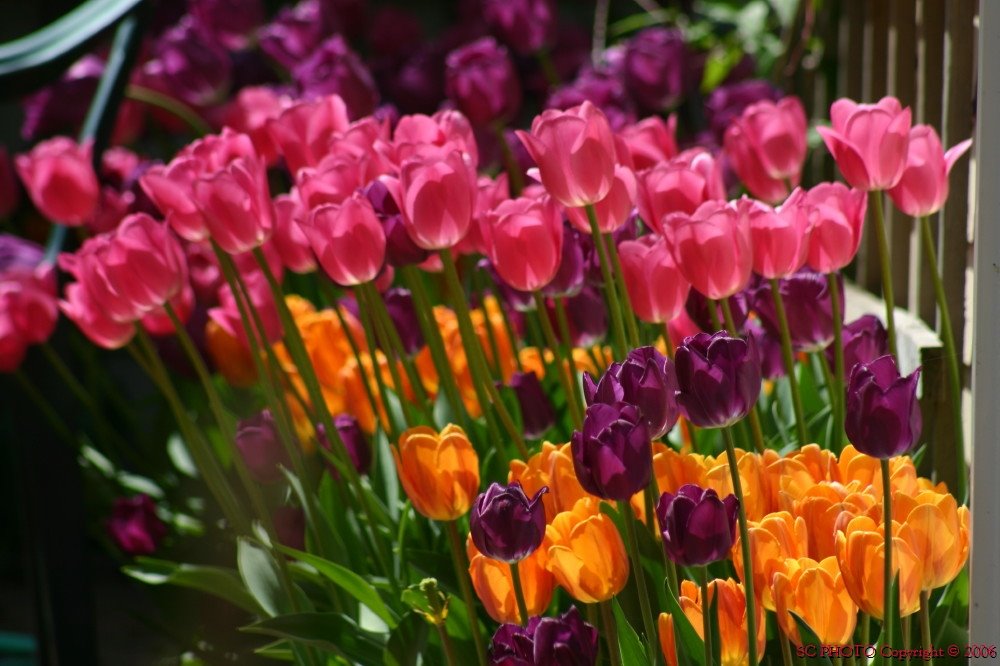
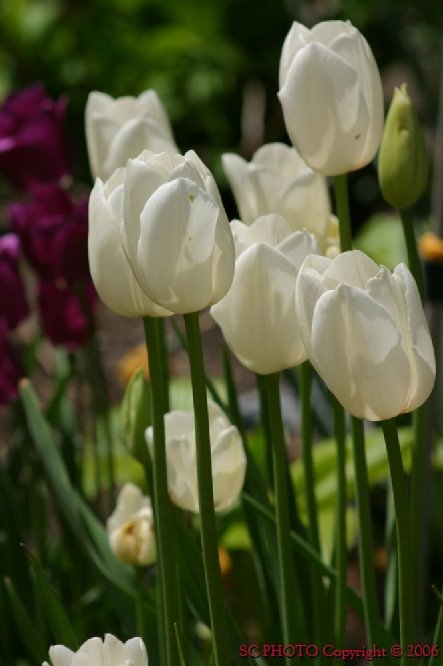
上周日阳光明媚。我背着相机在周围走了一圈。邻居们有漂亮的花园。拍了一些郁金香放在这里,祝我的妈妈母亲节愉快!祝我认识的妈妈们母亲节愉快!

(五月十六日补:我妈很喜欢这些照片。下回一定奉上真花一大束。我爸说:“取景很好,很漂亮。“ 其实,我只能哄一哄外行而已。这些只是糖水片,没什么新意。)







顽固的音乐

昨天傍晚干活的时候听音乐。 因为前阵子听多了古典,就听些流行吧。听了十首容祖儿,又听了二十首孙燕姿(小孙不错啊,第一次听,我想我已经落后一个时代了),中间听了Britney Spears的Baby, One More Time(非常符合她现在的状况啊)(瞧我这欣赏水平),再听了两小时Josh Groban,又看了ER,巨反战的一集。然后倒头欲睡,却发现容祖儿(第一个歌手哎!)已经顽固地留在我的脑海,不知是触动了哪根神经,无论我如何翻来 覆去也不能摆脱。痛苦,多花了一倍时间入睡,虽然已经累到不行。

早上吃早饭的时候听WCRB(我的古典电台),是莫扎特的双钢琴协奏曲K365,最后的欢快的乐章就印在了我脑海。必须说,这比容祖儿可要好多了。

五月十五日补:昨天晚上改成Vivaldi的《四季》了,具体的说是《夏》。电台昨天播了不下两遍。今天早上我想起了贝多芬的华丽的第五钢琴协奏曲《皇帝》,那第三乐章又是不停地在我脑中响起。

Friday, May 12, 2006

Nostalgia


My First School Library. Building is 84-years-old.
Photo Courtesy: Dr. Xiao


I checked my high school class homepage today, and saw that Dr. Xiao had uploaded lots of pictures of our school and its neighborhood. Suddenly I was hit by nostalgia. I was so familiar with that landscape, yet now I had to look hard to find the place that was ours. A lot of old buildings still exist. More new ones are making it a completely different place.


Stone Bridge. It is OLD!
Photo Courtesy: Dr. Xiao

I remember the river. I used to walk by it four times a day. I often walked with friends, talking about all sorts of things including what we’d be in twenty years (did I predict mine right???). We didn’t really enjoy the smell of the distillery on the river, but we did like the dried yams that were shipped there daily. And one day we chased a duck and a chicken into the river, only to be surprised that this chicken could swim! So much to the commonsense or knowledge from books!

We had a secret hiding place behind the school. A short hike led us down to the riverbank. We enjoyed basking in the sun, reciting the famous poem (野渡无人舟自横), and daydreaming. From there we forded a small creek to come to the foot of the reservoir dam. One day we thought we persuaded a girl from jumping into that reservoir. Of course this was probably all our imagination. But you can see that we learned to cherish life from a very young age.

Those were the good old days, fading back into my memories. When can we all get back together, telling each other our own stories of the past twenty years?

Saturday, May 06, 2006

The Joy of Printing


Columbines, Grand Teton National Park
Handheld, 1/15s


Many a night in a window-less room, where the only lights were a couple of faint red ones, I remember seeing images emerging from a tray of developer solution, ever so gradually yet decidedly. It felt like it suddenly opened a window to the world from that window-less darkroom. Be it a landscape picture, or a portrait of a loved one, it always gave one a mysterious feeling of how wonderful photography was. It was not just me. Other photographers told me that they loved this moment, too. That was why I enjoyed printing, the who process of making an image and improving it. Now we do most everything in a digital darkroom, but I still think I benefit a lot from my experience in a real one.


Grand Teton
I went to the same spot where Ansel Adams made his famous shot. The foreground trees had grown considerably taller.


Trees on a trail
那天下午我不自觉地做了一只大灯泡,对吧,Jade?

All photos taken on Kodak TriX 100. Printed on Kodak Multigrade paper.

快乐烦恼都是如此简单

Thursday, happy. Reasons:

a) First sunny day after three days of cold rain.
b) Protein expression worked super. Learned how to make it super.
c) First purification step worked super.
d) I jogged 1.5 miles after two weeks of zero exercise.
e) dogs were cute and sweet.

Friday morning, happy. Reasons:

a) One PI had a new baby girl.
b) Another PI had a successful heart transplant surgery.
c) Yummy breakfast.

Friday afternoon, frustrated. Reason:

In the second step of protein purification, where did 75% of my input go? No leaking was visible around the lines on FPLC.

Frustration lasted for two hours until we spotted liquid in the injection superloop jacket. Sure it was protein, and it took another two hours to confirm it was OUR protein. Damn superloop. Blamed the last person who used it. Of course it was someone from another lab.

Took another 30 minutes to convince myself to fix the superloop rather than using a smaller one twice. Took one hour to realize it was the O-rings that caused the problem and replaced them.

In the end, a two-hour run took us about 14 hours to finish. But I was happy because I figured out what the problem was.

Monday, May 01, 2006

An Interesting Test

Inspired by Roj, I finally did my Nerd, Geek, or Dork Test.

Guess what am I?

And what are you?

Thursday, April 27, 2006

A Witty Judge

British Judge Peter Smith's ruling in favor of "The Da Vinci Code" removed the obstacle to the release of the movie with the same title, which I expect to see very eagerly. Today I learned about Judge Smith's "Smithy Code" from an article in New York Times. Since articles on NYT website do expire after some time, I took the liberty of copying it here. Also provided is the link to the ruling in pdf on an official British government website.

I like this judge. His might be the only ruling I will ever read in my whole life. Haha.

_________________________________________________________________

Puzzle Embedded in 'Da Vinci Code' Ruling


By SARAH LYALL
Published: April 27, 2006

LONDON, April 26 — Justice Peter Smith's 71-page ruling in the recent "Da Vinci Code" copyright case here is notable for many things: the judge's occasional forays into literary criticism, his snippy remarks about witnesses on both sides, and his fluent knowledge not only of copyright law but also of more esoteric topics like the history of the Knights Templar.

But there is more to it than that. Embedded in the first 13½ pages of the ruling is Justice Smith's very own secret code, one that when partly solved reveals its name: the Smithy Code.

"The key to solving the conundrum posed by this judgment is in reading HBHG and DVC," the judge writes in the 52nd paragraph of the ruling, alluding to his code and referring to the two works at issue in the case —"The Holy Blood and the Holy Grail" and "The Da Vinci Code" — by their initials. (In the United States, the book is called "Holy Blood, Holy Grail.")

On April 7 Justice Smith ruled that Random House, publisher of the megaselling "Da Vinci Code," did not violate the copyright of "The Holy Blood and the Holy Grail," a nonfiction work published in 1982 that spins an elaborate theory about how Jesus married Mary Magdalene and how their descendants still live in southern France. Two of the book's authors contended that Dan Brown, who wrote "The Da Vinci Code," lifted the central "architecture" of their book and had thus violated their copyright. (The third author of "Holy Blood, Holy Grail," Henry Lincoln, did not participate.)

The decision was a resounding slap in the face to the two plaintiffs, Michael Baigent and Richard Leigh. But it was also an opportunity for Justice Smith to indulge in a flight of judicial and cryptological fancy.

The first clue that a puzzle exists lies in the typeface of the ruling. Most of the document is printed in regular roman letters, the way one would expect. But some letters in the first 13½ pages appear in boldface italics, jarringly, in the midst of all the normal words. Thus, in the first paragraph of the decision, which refers to Mr. Leigh and Mr. Baigent, the "s" in the word "claimants" is italicized and boldfaced.

If you pluck all the italicized letters out of the text, you find that the first 10 spell "Smithy Code," an apparent play on "Da Vinci Code." But the next series of letters, some 30 or so, are a jumble, and this is the mystery that needs to be solved to break the code.

In a brief telephone interview on Wednesday, Justice Smith declined to provide a solution for a puzzled reporter. Nor would he explain how he had put the code in his ruling, or how long it took him to figure out how to do it.

"I can't discuss the judgment until after I retire," he said.

But in a series of brief and ultimately frustrating e-mail messages during the last couple of days, the judge provided a series of intriguing clues. First he said that the different ways codes are broken in "Holy Blood, Holy Grail" and "The Da Vinci Code" should be considered. The idea for the italicized letters, he suggested, came from "Holy Blood, Holy Grail."

He then suggested moving on to "The Da Vinci Code" and applying one of the code-breaking methods used by its protagonists to solve the mystery of the jumbled letters. "Think mathematics," he wrote at one point. He drew attention to his own entry in Who's Who — in which he lists an interest in the history of Jackie Fisher, an admiral who modernized the British Navy, a possible reason that his e-mail address contains the word "pescator," implying fisherman — and said that the date 2006 was significant.

He even mentioned a page number in "The Da Vinci Code" by way of trying to help. But he declined to go further, saying that "anything else gives it on a plate."

It has been nearly three weeks since he handed down the ruling. Probably disappointingly for Justice Smith, nobody seemed to notice anything unusual about it when it was first released. But he alluded to the possibility that there was something more soon afterward as a throwaway line in an e-mail exchange with a reporter for The New York Times, saying, "Did you find the coded message in the judgment?"

On vacation in Florida, the judge then declined via e-mail to elaborate much further, other than to refer to anomalies in the typeface. "Start with 's' and keep looking up to Page 18 approximately when the fonts stop," he wrote.

Meanwhile, back in London, Daniel Tench, a partner at the law firm Olswang, was reading the ruling and noticed something odd about the type. "At first I thought it was a mistake," he said on Wednesday. "It's not usual practice for a High Court judge to issue a ruling in which he has hidden an encrypted message."

Not knowing if there was anything there, though, Mr. Tench mentioned it to a reporter who compiles a column about legal affairs for The Times of London. After that paper printed a small item quoting him discussing the typeface, Mr. Tench was nonplussed to receive an e-mail message from Justice Smith confirming that yes, there was indeed a code, but that Mr. Tench had missed the first letter "s."

"It is always best to start at paragraph 1!" the judge wrote.

Speaking to the Bloomberg news service late on Wednesday, Justice Smith once again declined to provide any answers. Explaining why he made up his own code, he said it was "a bit of fun."


________________________________________

Added April 28, 2006: Today came the report that the code had been broken. Lawyers in the Olswang law firm deciphered the "Smithy code" as “Jackie Fisher who are you Dreadnought.” Of course this took almost two days of precious (lawyer) time, and many hints from Justice Smith Peter. The Justice confirmed it and also explained that the code is based on letter substitution by applying the Fibonacci Sequence, through the number 21 (1, 1, 2, 3, 5, 8, 13, 21). Thus "JAEIEXTOSTGPSACGREAMQWFKADPMQZVZ" becomes "JAFKIEFISHERWHOAREYOUDREADNOUGHT". Of course Justice Smith intentionally left a typo in the third letter to confuse the codebreakers.

I found this code even harder than all the puzzles in DVC and Dan Brown's other book, Digital Fortress.

Monday, April 24, 2006

艺术和政治

这个是有感于Jade的博文《Isaac Stern》而发。

自从大学毕业那年读过一本有关邓小平在文革末期的书,我就对政治彻彻底底的丧失了原本仅存的一点点的兴趣。我从来就不是当领袖人物的料,我还是老老实实研究自然现象好了。可偏偏对人文艺术有些爱好,就听听音乐看看画,附庸风雅一番。我对艺术家的研究也不深入,比如Isaac Stern, 我只知他小提琴拉得好,全然不知傅聪和他有这么大的过节。

今天和有以色列血统,并对音乐有深入研究的Milan谈起Isaac Stern,话音未落就见Milan摇头,:“此人太自我(big ego)."再谈到政治,Milan也对Isaac Stern对政治的狂热不胜感冒。不过我们都对Isaac Stern发掘出马友友和Itzhak Perlman等人,以及拯救Carnegie Hall的事迹非常敬佩,当然还包括他的音乐。

我在想,民族主义(Nationalism)和政治狂热的界限是什么?我爱Nationalism的音乐,比如Smetana的《我的祖国》(Má vlast),尤其是其中的《沃尔塔瓦河》(The Moldau)。可艺术和政治究竟是怎样的关系呢?艺术都是为政治服务的吗?最近我的一个学作曲的朋友有感而发:“我们这些学艺术的,很容易就触动政治神经。"

这个题目实在已经超出了我能驾驭的范围,我还是住嘴了罢。

Saturday, April 22, 2006

More Birds

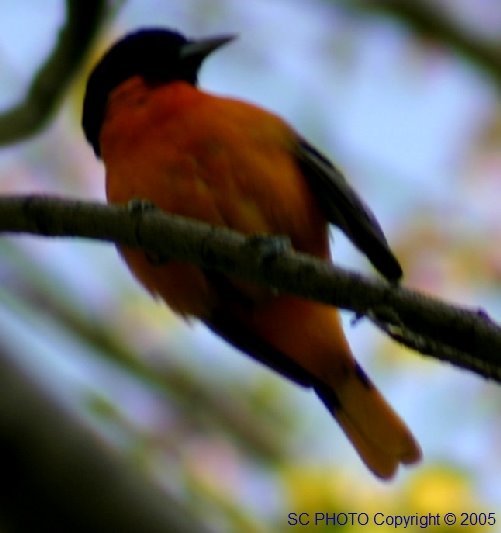
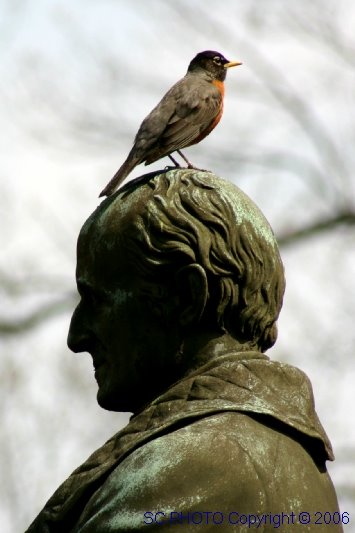
We have a bird expert here! Thank you, Anonymous! I'm posting more bird pictures. I saw them last May 14 at Mount Auburn Cemetery. In fact, it is a great place for bird watching. I bumped into a group of bird-watchers on a small hill, with their high-power binoculars and super telephoto lenses. My telephoto at the longest end can not product crisp sharp pictures. So here are the somewhat blurry pictures of three (different) birds. What are they?


Bird

On top of a Bowditch sculpture at Mount Auburn.
Do you know what kind of bird he is?

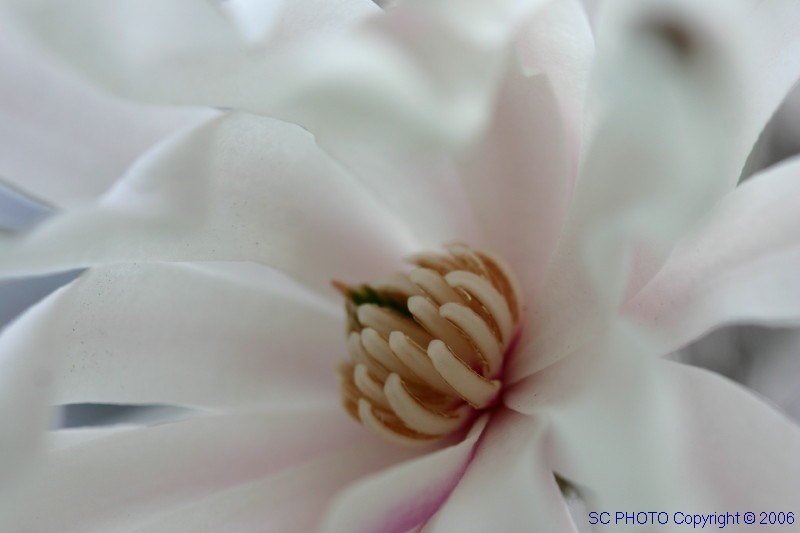
花心

“花的心 藏在蕊中 空把花期都错过”

那些错过的时光啊!

Star Magnolia, April 15, 2006
Mount Auburn Cemetery, Cambridge

Tuesday, April 18, 2006

A Newspaper Review of Li and Lang

Thanks to Sharon for sharing this article with me. I really enjoyed reading it.

So now to end the duel once and for all, here it is

________________________________________________________________________________

Protege pianists Lang and Li need to cool the duel: Time to extinguish
destructive flames of meaningless competition
Mark Swed
Los Angeles Times
5 April 2006
Vancouver Sun
Copyright (c) 2006 Vancouver Sun

In one corner, Lang Lang. Born in 1982 in Shenyang, China, he has
knocked out Rachmaninoff on countless occasions. Tchaikovsky,
Mendelssohn and Chopin never have a chance once he gets his mitts on
them. Last month in Los Angeles, he gave Bartok a going-over not soon to
be forgotten. Charismatic poet and flashy dancer, Lang Lang's the champ.


In the other corner, the steely challenger, Yundi Li -- who plays here
Friday at the Orpheum. Also born in 1982 and from Chongquing, China.
He's a world-class Chopin and Liszt slayer. He's fast as lightning, and
his aim is deadly.

Each fighter has in his corner bloodthirsty music management. The
record label Deutsche Grammophon is the match sponsor. The stakes are
high, and the gloves are off -- they have to be, the contestants are
pianists. Somebody's bound to get hurt, and I can hardly ....

Hey, wait a minute! It's not supposed to be like this!

The rivalry between two young pianists just out of protege puberty has
gone too far. Nothing good -- unless you think short-term record company
profits are all that matter -- can come from it.

That Lang and Li are adversaries is no secret in the music industry.
Lang is the hottest young pianist around and has been for some time. But
the ambitious Li is doggedly nipping at his heels.

It can seem cheap to bring up such matters in polite classical-music
society, and most musical journalists have tried to be as circumspect as
they can be. It is all too easy to slip into cultural stereotyping, to
wound fragile young egos. Two years ago in the Boston Globe, Richard
Dyer did courteously confront Li with the question and Li just as
courteously skirted it, noting that the pianists had met only recently.
"I think we are friends," he said.

The fact is, whatever these young men feel about each other, a
commercial rivalry is being fuelled by their keepers. San Franciscans
hardly could have been expected not to notice when the pianists played
back-to-back recitals over two nights in 2004. But by then both were
high-profile Deutsche Grammophon artists, so the spirited scene was well
set.

This year the ante was raised substantially with DG's competitive
release of recital discs by Lang and Li that include the same Mozart
sonata -- K. 330 -- and very similar programs. Lang plays Schumann's
Scenes From Childhood, Li takes on Schumann's Carnaval. Lang concludes
with fingers flying through Vladimir Horowitz's arrangement of Liszt's
Hungarian Rhapsody No. 2. Li races through Liszt's Rhapsodie Espagnole.
The main difference in repertory is that Li plays two sparkling
Scarlatti sonatas, whereas Lang tackles the more substantial Chopin
Third Sonata -- but he needs a bonus disc to make all that music fit.
The bigger name, he gets it.

Lang's, it turns out, is his least interesting recording, while Li's is
his finest by some measure. Comparing them, Li, a normally less
compelling (although no less accomplished) player than Lang, might be
closing in on his opponent. But both pianists are at awkward points in
their careers, and frankly we need neither disc.

Let's start with Lang. He is, without doubt, a tremendous talent and an
abused one. His big break came in 2000, when he substituted at the last
minute for Andre Watts in a performance of the Tchaikovsky Piano
Concerto with the Chicago Symphony. The critical response was ecstatic.


He looked younger than his 17 years. He was adorable, and his technique
was beyond belief. Managers wanted a piece of this action. Why wait for
him to undergo the long and uncertain process of growing up and finding
out who he really was as an artist? He wouldn't stay cute forever, after
all.

Before long, Lang began playing up the endearing factor, seeming happy
to do anything for audience approval, grimacing and gyrating, stretching
musical phrases like taffy, or playing so fast his fingers were all a
blur. But now Lang's early champions were repulsed. Growing up fast, he
wasn't quite so cute anymore.

For his next recital album, Memory, which was made in the studio, Lang
has gone in the opposite direction, toning it down too far. The program,
he notes in the booklet, is a personal exploration of the music he grew
up with. But Lang's youth was not that long ago, and he hardly shows
himself ready to be rethinking music that he does, in fact, need to
rethink. Rather a kind of sentimental preciousness creeps in. Tempos
tend to be slow and dreamy, which is particularly toxic in Mozart.

But his tone is pure gold, and his liquid phrasing still approaches
poetry. His flamboyance shows through now and then, as in the
ferociously difficult Horowitz/Liszt arrangement. It is a lot of shallow
fun.

Lang should stop reading his press, this example included, and stop
listening to money men and women and begin relying more on his own
pianistic instincts. Yundi Li, too: He, more than anyone, should stop
reading Lang's press.

Apart from being the same age, growing up in an obscure Chinese town,
recording for the same label and playing a lot of the same Romantic war
horses, Li is nothing like Lang. His big break came a year after Lang's,
when he won first place in the Chopin Competition in Warsaw in 2000. Two
years later came his first DG recital disc, all Chopin, with the
20-year-old pianist photographed to look younger and androgynous. The
selling of Li had begun.

It's a dry recording. His tone is hard and clear. The precision of
attack is startling, but the music-making is ultimately mechanical. It's
reminiscent of Horowitz without the oddities.

From the start, Li has presented himself as an unusually serious young
man, who would never sink to Lang's grandstanding, while making sure we
noticed that he has the technique to do so if he wanted. A Liszt CD that
followed his Chopin recital was just as flat.

In a clear effort at Langian one-upmanship, Li's latest recital was
recorded live at the Musikverein in Vienna, Austria, the one concert
hall even more glamorous than Carnegie. And some of the playing here is
smashing. The Scarlatti sonatas are scintillating. Li's Mozart is crisp,
quick, transparent. But in Schumann, Li reverts to his earlier type.
Each movement is meant to reveal a distinct pianistic personality, but
with Li they all sound the same. Liszt's Rhapsody Espagnole shows
superhuman meticulousness and speed, but somehow it is not much fun.

It's time to turn the heat down on both pianists and to stop feeding
the destructive flames of their meaningless competition. And their own
label might be doing just that, though no doubt inadvertently.

Colour Photo: Chinese pianist Yundi Li performs at the Orpheum on
Friday.; Colour Photo: Photo courtesy Deutsche Grammophon / Lang's big
break came in 2000, when he substituted at the last minute in a
performance with the Chicago Symphony. He looked younger than his 17
years. He was adorable, and his technique was beyond belief.; Colour
Photo: Photo courtesy Deutsche Grammophon / Li has presented himself as
an unusually serious young man, who would never sink to Lang's
grandstanding, while making sure we noticed that he has the technique to
do so if he wanted.

Document VNCS000020060405e24500026

I wrote about Lang Lang Last Year

Lang Lang Playing His Third Encore


I went to Lang Lang's recital in Boston in March 2005. That was pre-blog era. I wrote about his concert in emails I sent to friends. I'm now posting it here. I didn't have my telephoto lens with me, and I was only shooting JPEG. Photo qualities were not optimal.

-----------------------------------------------------------------------

Last Wednesday I went to Lang Lang's piano recital at the Symphony
Hall and I had a great time. Though I had seen Lang Lang's performance
in the Mostly Mozart Festival on TV some 20 months ago and marveled at
his most expressive playing, it was still very exciting to see him
live on stage in Boston. It was a sold-out performance and 10 minutes
before the show people were still waiting in long lines outside the
Hall. The recital was about 2 hours long and after the very first few
notes of Mozart's piano sonata in C Major, Lang Lang had already
grasped everyone's attention with the elegant and delicate music. In
this recital, Lang Lang showed the audience that he could do anything
with the piano, as delicate as Mozart, or passionate as Chopin, or
romantic as Schumann, or technically difficult as Rochmaninoff and
Liszt. I really liked his playing (or shall we say, Horowitz's
transcription) of Lizst's Hungarian Rhapsody No. 2. It was witty,
mischievous, humorous, and joyful. He received standing ovations from
the audience and had to play three encores. The first one he played
was a Chinese piece 平湖秋月 and was well received by the audience (at
least 90% American by my estimation). After the recital, just like
hundreds of other fans, I bought his CD and waited in line to get his
autograph. He also posed with us for photos. With his tender age of
22, he looked no other than just a big boy, yet his achievement made
my friends and me wonder what we had done with our lives. We all
agreed that he was very cute. Oh well, I have to say, that I might
have found my new idol after Faye Wong ceased to be some 5 years ago.
I highly recommend his performance if he happens to tour your city one
day.


Modern Technology and a Happy Young Fan


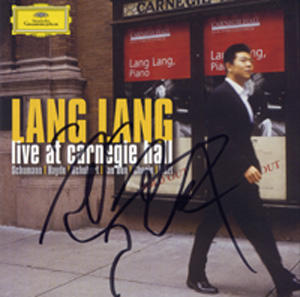
The CD Jacket With Lang Lang's Autograph
I can't find it anywhere. Had anyone borrowed it from me?

Monday, April 17, 2006

Yundi Li in Concert


I went to Yundi Li’s recital at Jordan Hall last Saturday thinking of comparing him to Lang Lang, whose recital last year at the Symphony Hall really impressed me. Half way through Yundi’s playing, I knew that I had also become his fan. Sitting on the left balcony I could see clearly how his fingers had been flying all over the keyboard playing Mozart, Schumann, Liszt, and Chopin. I have no word to describe his technique except to say, “Fantastic! Amazing! Unbelievable!” Being at best a music dilettante, I am in no position to tell the difference of his playing and Lang Lang’s, other than that both are marvelous. Not being able to see his face during the concert (the price you pay if you want to see his hands), I also could not tell whether he was as flamboyant as Lang Lang (most probably not), but their smiles at the end were all the same, from the bottom of their hearts.

OK, I am getting tired hearing people comparing these two excellent young Chinese pianists (though I myself had been doing that only days ago). I simply love them both! They are now my idols of equal importance. I will support them through their careers.


The Stage Minutes Before Recital


Receiving Applause After Schumann's Carnaval


Playing Encore, A Chinese Piece
Who got the name?


CD Signing

Well, there is one thing to complain about Yundi. That is he did not allow fans taking pictures with him. Of course this expedited his CD signing and let him take a break from an already long day, but I felt that his PR probably could have done a little bit better, not to make him look like escaping from his enthusiastic fans (mostly young ladies in this picture :-)).


我的摄影水平快赶上娱乐记者,俗称"狗仔队"了。

Friday, April 14, 2006

Radar and Daffodils

Spring is really here!
Puppy Radar is enjoying sniffing daffodils.

This afternoon Radar took out two dog-walkers, including one with heavy camera gear, for a walk on campus to enjoy spring (the dog-walkers think so). He broadened his fan club (as always), and also made friends with three other dogs (one of them is also named Radar). But towards the end, an over-excited Radar dashed towards a toddler in a stroller before his walkers could catch him, and jumped and kissed the scared and crying toddler. His dog-walkers reached him only after he had expressed his affection towards the kid by planting a dirty spot on his forehead. The kid stopped crying shortly after being comforted by several adults, including Radar's two guilty, incompetent walkers.

Radar posed with the flowers as a way to show his sincere apology for jumping at the kid.

Added April 24, 2006: Radar, 有人说你“人模狗样“呢!

Thursday, April 13, 2006

Spring Has Arrived


Sunday April 9th. Mt Auburn Cemetery, Cambridge.

Sunday, April 09, 2006

雅兴大发

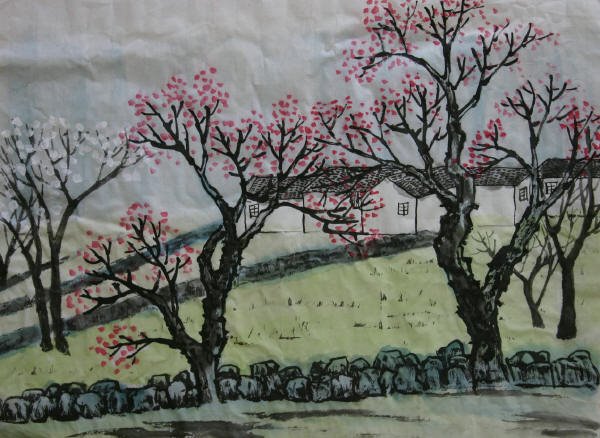
真难得啊,今天在家画了两个多小时,完成了星期三课上开始的一幅。


另外还拯救了练习时画的两棵树--这两棵树呢,我自认为枝条画得还不错,不过一边一棵,犯了构图的大忌,实在没有艺术美感。于是加了几棵树,添一面矮石墙和几户人家,就成了江南之春啦!

Thursday, April 06, 2006

Caltech Cannon Taking a Break at MIT

Here.

per te

Italian, "for you". Word I learned today.

English word I learned today:
hobbledehoy
noun: an awkward, gawky young fellow.

I wish I know more words or languages.

Tuesday, April 04, 2006

How Money Is Wasted

We got a shipment yesterday, a big package with 9 kilograms of dry ice. Inside this big box was 250 micrograms of 1Kb DNA ladder. We had to dig through 9 kg of dry ice pellet to find this small red/white box.


Ten minutes later, another identical looking box arrived, from the same company, also with 9 kilograms of dry ice. Inside was 1 milliliter of prestained protein markers.


OK, we did order them on two different days last week. But isn't it a good practice to try to consolidate shipments if possible? Both were shipped on last Friday, within one hour, via the same carrier. And 9 kilograms of dry ice? Even though this was over the weekend, it still seems an overkill. Well, at least I found a place for the dry ice. I donated it to the lab where I always steal dry ice from. They were happy to have it to fill their almost empty dry ice chest.

Monday, April 03, 2006

Parking, Amsterdam Style

Photo: Courtesy of Milan

Imagine parallel parking here.

I dare NOT try.

Merrily We Roll Along


The Longwood Players' new play, Merrily We Roll Along, is actually a musical. It was quite an experience to see it on Saturday, in the almost packed YMCA theater. It was only the second musical I've seen in theaters. Compared to Broadway productions, there is definitely room to improve in singing, but over all it is very impressive for a small group (18 actors) to put up such a show (it runs for almost two and a half hours) with live music and acting in such a short time.

It is said that it took Stephen Sondheim and George Furth nearly fifteen years of tinkering before getting "Merrily We Roll Along" right. Apparantly I wasn't able to associate their names with entertainment before I went to this show. Though Sondheim is quite big, I thought most songs sound too plain to me. That is, they are not very tuneful. Nevertheless, there are several numbers that are quite memorable.

The story is about a successful composer (yet he had lost everything - love and friendship) and his two best friends. It begins at the end of their friendship, and goes back through times of their lives. It was a little hard for me to get it at the beginning (just like the movie Momento). Luckily it soon got better. In the end we knew all the answers. We saw three young aspiring artists on a New York rooftop in 1957, watching the first man-made satellite, dreaming about their future. It is a better ending than the other way around. At least we can still dream about the paths they could have taken, all the possibilities in their future, and how nice it is to be young.

For a review of this production, see here.


Young and aspiring
A pre-dawn pajama party on the roof


The set. Foreground lights dim. Lighting from behind.


The set. Full view.
I helped (a little bit) painting it.

Wednesday, March 29, 2006

Josh Groban, A Beautiful Voice


The first time I heard Josh Groban was on one episode of Ally McBeal. That was the December after 9/11, and the episode was dedicated to its memory. Josh sang a most beautiful song, To Where You Are, at a memorial service for the fallen firefighters of this little town. It was very very moving and I had to watch the song again and again. I really love his voice. It is pure and powerful. Over the years I came upon his duet with Charlotte Church, The Prayer, which is also very beautiful. I hoped I could hear more of his songs, and yesterday I found not only one, but two albums from my local library! I was very very happy!

Looking through the CD inserts, I learned that "To Where You Are" was written by Richard Marx. No wonder it is so romantic (remember his "Right Here Waiting"?)。 一如Jade语,“浪漫地撒狗血“(出自Jade's post 一天生活流水账)。To hear his songs, you can go to his official website, and click Music to play a song on the upper right side, or you can go here.

Isn't he great?还是帅弟一名啊!

Added on March 31, 2006: I found myself hopelessly fell in love with Josh's voice. It is so romantic and powerful. It is the best crossover between classical and pop.


"To Where You Are"

Who can say for certain
Maybe you’re still here
I feel you all around me
Your memories so clear

Deep in the stillness
I can hear you speak
You’re still an inspiration
Can it be (? )
That you are mine
Forever love
And you are watching over me from up above

Fly me up to where you are
Beyond the distant star
I wish upon tonight
To see you smile
If only for awhile to know you’re there
A breath away’s not far
To where you are

Are you gently sleeping
Here inside my dream
And isn’t faith believing
All power can’t be seen

As my heart holds you
Just one beat away
I cherish all you gave me everyday
’cause you are mine
Forever love
Watching me from up above

And I believe
That angels breathe
And that love will live on and never leave

Fly me up
To where you are
Beyond the distant star
I wish upon tonight
To see you smile
If only for awhile
To know you’re there
A breath away’s not far
To where you are

I know you’re there
A breath away’s not far
To where you are

Wednesday, March 22, 2006

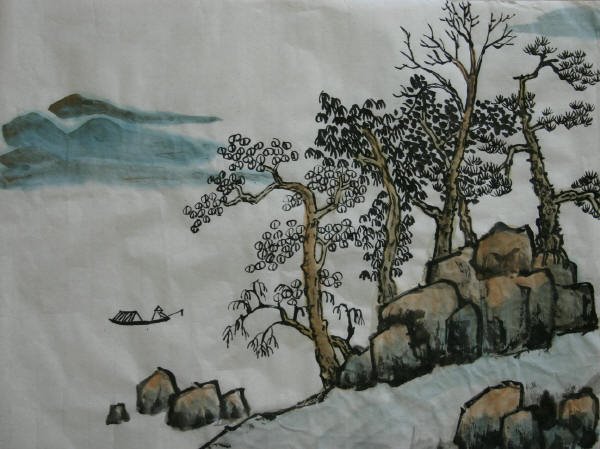
我的第一幅山水


又学了六堂山水课,终于画出了一幅东西。只能算半成品吧,因为觉得缺了点鸟儿啊,船什么的。过几天再画吧。

山水真是比花鸟难很多。功夫都花在基本功上了。前四堂课画了四礼拜的树,从枯树的树干画起。这两周画的是石头,下四周要把它们放一块了。

Tuesday, March 21, 2006

My 360 Pixels on Nature.com


This picture is linked directly from Nature.com. It is only 60X60 pixels. I can't make it to display any smaller here.


Ok, this is actually about Milan's Graduate Journal in Nature, the most prestigious science journal that every scientist dreams to publish in (ok, there are also Science and Cell). I only found out that Milan has a column in Nature today, and he has already published two journals! Mmm, I wonder why I am always the last one to know this sort of things.

Milan is a very good writer. I had enjoyed reading his blog (Milog on my sidebar) back in the days when he regularly updated it. I remember telling him, "Maybe you should make a career in writing or editing or publishing." So I heard that Nature saw his blog and then asked him to contribute to a column. Well, I need to confirm this with the author, but for now, we'll believe that it did happen that way.

Checking out the page I saw a familiar picture. It looks like a portrait of Milan I took last year. And I remembered that he asked for that picture about two months ago. It all came together just like that! It is confirmed by the author that his picture on Nature.com is my work.

Oh wow! Now I have 360 pixels published on Nature.com. Too bad it is not credit to me. Too bad it is not my scientific contribution to the human kind. Still a long long way to go!

Monday, March 13, 2006

A Man Among Orcas

Orca
n : predatory black-and-white toothed whale with large dorsal fin; common in cold seas [syn: killer whale]


Picture: Courtesy of David Reichert

David Reichert and Friend

Wildlife filmmaker David Reichert befriends an elephant seal during shooting for A Man Among Orcas. The Crozet Islands are so far removed from human civilization that many of the animals living there have never seen a person before. With no reason to fear this peculiar, two-legged creature, the seals reacted to David with nonchalance and even curiosity.


Checking my email at 5:30pm, I found a new message from V, my first roommate when I started graduate school. She wanted us to watch a documentary on Animal Planet about a wildlife photographer filming orcas (and other wildlife) in the Crozet islands. Then she said, “That photographer happens to be my brother.” She apologized for the late notice. She was in Australia. Things were a little crazy before she left. She sent the email at 5:19pm EST, and the premiere of the documentary was 7pm.

I hurried to finish my work and got home in time for the program. I’ve heard from V that her brother is a photographer and makes films, but today is the first time that I saw his work and saw him working. The documentary started from David’s preparation back home in Jackson Hole, WY, for the trip to Crozet Islands in the southern Indian Ocean. Eleven suitcases were packed including three cameras and underwater housing, among other things. Everything has to be in the best working condition. David would stay on the island for 4 and a-half months.

The Crozet Islands are a volcanic archipelago belonging to the subantarctic island system. It is extremely and constantly windy and no trees can grow there. The weather changes dramatically and it rains almost everyday. However, the islands host a lot of wildlife found in this remote area of the world. David settled down among the king penguins, elephant seals, sea birds, and orcas. This documentary reminds me of “March Of The Penguins”, which I really love. But unlike the best documentary of the Academy Awards, David’s documentary did not overly portrait penguins as humans (such as “love is the only thing that concurs all”). He simply showed us how beautiful these king penguins were, and how cute their chicks were. But they, as cute as they are, are still below in the food chain for the orcas.

Another prey for the orcas are the elephant seal. I have to say that I find male elephant seals ugly. I especially don’t like their trunks that earned them their name. But I do like their pups. With their big watery eyes, long whiskers, chubby bodies, and wrinkly skin, they easily win my heart over. One pup’s mother abandoned him early, because she herself was starving. Desperately seeking another mother for nursing, the pup was only turned down and thrown out every time. The poor pup looked at David for help. But the human being had no way to help it through. This was just like one of those heartbreaking moments in “March Of The Penguins”. Nature is sometimes so cruel.

Orcas live in small, close-knit family units called pods. A pod usually has a matriarch, who can live up to 90 years (Wow!). They hunt together and sometimes they would deliberately strand on beach in order to catch prey. To get close to the orcas, David waded through the marsh, climbed up the cliff, and found the best observation point. David also dived to shoot footages of orcas. It was amazing to see him only feet away from the pod of killer whales. Maybe he really gained their trust by observing them for months.

I am always fascinated in programs of Nature. This one is very special, because it features V’s brother. It reminds me of not only how hard life is for the animals out there, but also how much the filmmakers had to endure to make documentaries. The trip from Wyoming to the Crozet Islands took David 3 weeks. After that it was 4 and ½ months among the animals. This is hard work. I really enjoyed the program. My many thanks to David and V.

Friday, March 03, 2006

George Washington’s Dentures


What's wrong with his mouth?


One thing I learned this week is about Washington’s dentures. While reading the February issue of National Geographic one evening, I became totally fascinated by one fact in a short article about reconstructing Washington’s image: he owned some dentures that were made from not wood, but human teeth!

Talking to my colleagues the next day, I was surprised to find that the myth of Washington’s wooden dentures is widely spread. After researching online about this subject, I learned more about Washington’s serious dental problems in his lifetime. By the time of his inauguration as America’s first president in 1789, he had lost all but one tooth. He was only 57 then. He had many dentures made but none of them really fit. That is why you see him pouting in most of his portraits – because he had to close his mouth shut to keep his denture in. And the human teeth in his dentures are most likely his own.

Oh that makes me feel less awful! How could you keep someone else’s teeth in your own mouth? It is just weird. I’m all for heart transplants, kidney transplants, to name a few. But I am just not ready for human teeth denture yet.

Luckily I have good teeth. One physician saw my teeth and commented: “they grow good teeth in China.” Of course this is all my parents’ credit. Besides, my grandpa, who is 91, also has good teeth. It seems I have the good tooth gene. I shall not worry about human teeth denture.

To see a picture of GW's dentures, click here.

Word of the Day -- Dilettante

Word of the Day for Friday March 3, 2006

dilettante \DIL-uh-tont; dil-uh-TONT; dil-uh-TON-tee; -TANT; -TAN-tee\, noun:
1. An amateur or dabbler; especially, one who follows an art or a branch of knowledge sporadically, superficially, or for amusement only.
2. An admirer or lover of the fine arts.

Dilettante comes from the present participle of Italian delittare, "to delight," from Latin delectare, "to delight," frequentative of delicere, "to allure," from de- + lacere, "to entice."

What a coincidence! It sounds just like ME!