Yes, stargazing is still my obsession.
How rare is a full blue moon? (From Earth & Sky)
Tonight's Sky for Tuesday, May 01 2007
The moon will look full tonight, lighting the night from dusk till dawn. In the Americas, though, the moon won’t be truly full till tomorrow morning, at 5:09 a.m. Central Daylight Time. For the Americas, tomorrow’s full moon will be the first of two full moons in May. The second full moon to occur in a single calendar month is popularly known as a blue moon. We elaborate on today’s radio show.
Every 19 years, the phases of the moon recur on (or near) the same calendar dates. So in 2026, there will be two May full moons. Once again, the second full moon will be dubbed a blue moon.
This famous 19-year cycle reveals how often blue moons occur. Every 19 years, there are 235 full moons – yet only 228 calendar months. Therefore, the 7 leftover full moons (235-228=7) have to share the same calendar month with another full moon. That gives 7 blue moons in 19 years.
Yet, there’s one big hitch! February of 2018 has no full moon whatsoever. That’s another displaced full moon that falls right into the lap of March. So that’s a total of 8 blue moons for the next 19 years.
Written by Bruce McClure, 1 May 07
Showing posts with label Science. Show all posts
Showing posts with label Science. Show all posts
Tuesday, May 01, 2007


Wednesday, April 18, 2007
Radar and Beer
Well, apparently Radar doesn't like beer. He was very hesitant when introduced to some oh-I-don't-know-what-brand beer: he tasted a little bit very cautiously, and then waited for 5 minutes. When convinced he was not going to get anything else, he tasted the beer again. Then another 5-minute's wait. Eventually he finished it.
In contrast, he loved vodka/tonic water. He gulped this mix just like he drank water.
So our conclusion was: dogs don't like beer; they like vodka.
Just when we felt good about our new scientific discovery, V found this article in THE ONION:
Unemployed Scientists Prove Dog Likes Beer
What the XXXX is going on!
V's comment: these guys are working on our project (with opposite results), they
even plan to test Andy's idea at the very end... we have to publish before we get scooped!
Wednesday, February 28, 2007
Journal Club Paper
Really an easy read: two and a half pages long, with two figures. The first panel (of two) in figure one is previously published. Apart from the short length of the paper, what impressed me most is this:
Original manuscript submitted: 12/20/06
Manuscript accepted: 12/26/06
Mind you, there was a major holiday in between.
这,才叫牛!
Original manuscript submitted: 12/20/06
Manuscript accepted: 12/26/06
Mind you, there was a major holiday in between.
这,才叫牛!
Sunday, February 25, 2007
Crystallographer No More :(
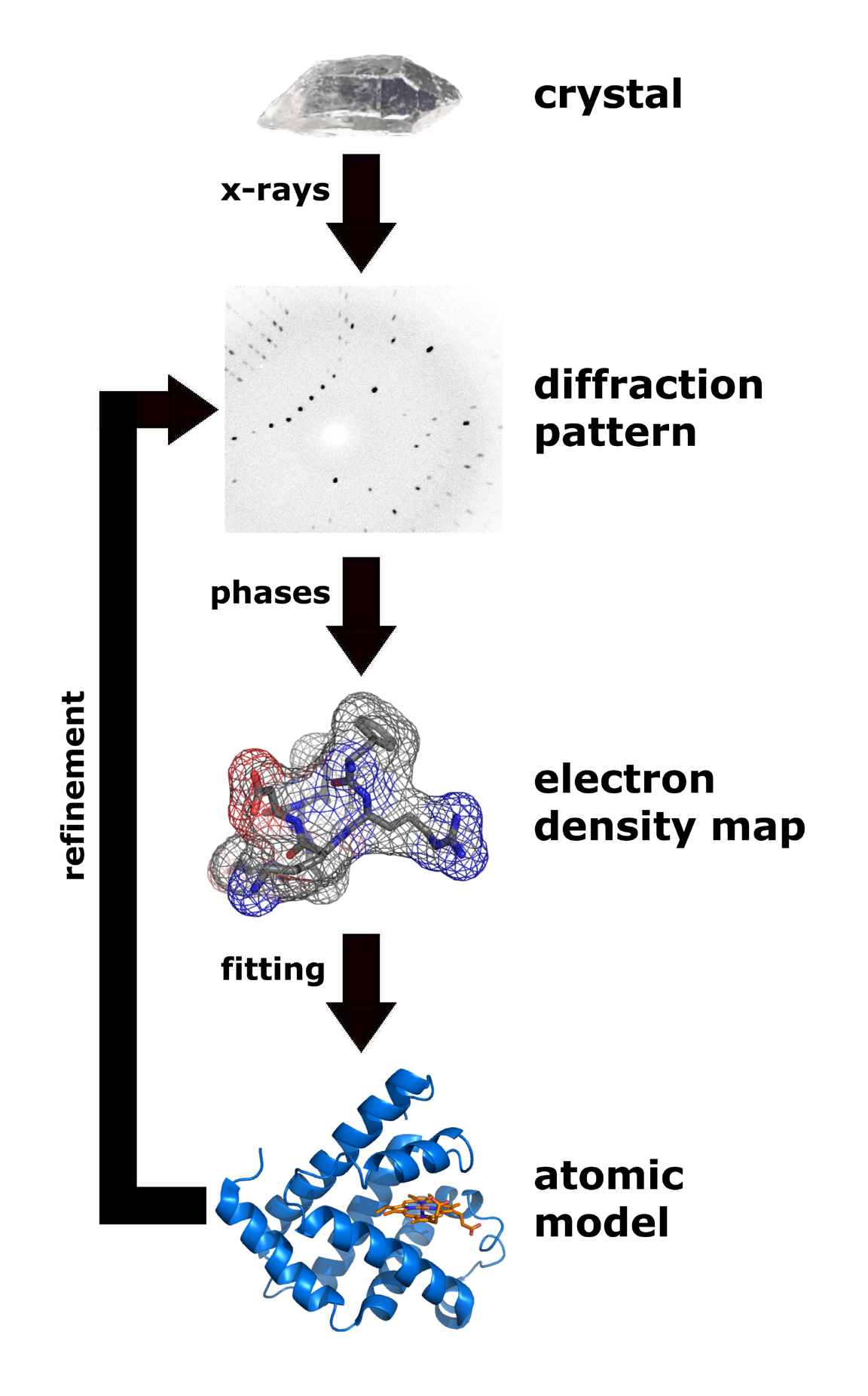 Image borrowed from Wikipedia
Author: Thomas Splettstoesser
Today I disappointed myself (don't I do that everyday?). Our newcomer T came to me for help with his crystallography homework assignment after hearing that I was a crystallographer. I completely forgot how diffraction patterns are related to crystal lattices, or space groups, or how many asymmetric units there are in any unit cell of a space group. Suddenly I felt so inadequate as a PhD. After many years of training, and many years of not using the knowledge, I am no longer a crystallographer! It is embarrassing, and I feel really sorry to Profs. T, N, R, and P. So I brush up my geeky crystallography knowledge (with the help from wiki), and hopefully tomorrow I will be able to help T.
BTW, T's homework has a really pretty diffraction pattern: a tetragonal crystal's h0l, more regular and impressive-looking than this one.
Tuesday, February 06, 2007
Johnson Space Center
Oh my, don't we all like to gossip! I guess the astronaut love triangle / attempted murder is hot news today. Apparently love drives one crazy, even astronauts can't be spared.
I visited the Johnson Space Center (JSC) on the last day of 2006. I am posting some pictures in case you haven't been there yourself. As you might know, JSC serves as the mission control center for all the space shuttle flights and much more. Remember the famous "Houston, we've got a problem"?

No shuttle was in space that day, plus it was a Sunday, so the control room was empty. But you still can see on the screens where the International Space Station (ISS) was currently orbiting the earth, and live video feeds from the ISS.
 Training facility
 Rockets
 Why did I become suspicious about the Moon project after I saw the exhibition?
Maybe I should spend more time reading about it.
Bonus pics:
 Houston
 At sunset
The last ray of 2006
Tuesday, October 17, 2006
坚强地面对现实
我检讨,我对科学不够关心。我的这个小领域最近出了学术丑闻我到今天才得知。其实,八月底就察觉到有什么不对劲:一篇文章EPub了两天就被作者撤回。当时我就有疑问,为什么要这样做呢?EPub之前干什么去了?
今天才知道,这件事(还涉及到其它的文章)的whistle-blower,这个日本实验室的助理教授,在告发了正教授作假之后,在需要到调查委员会前作证前两天,选择了自杀以结束自己的生命。多么的可悲及可惜!
想到前些日子J着迷的日剧《白色巨塔》,见习医院里副教授和正教授的明争暗斗,以及日本学术界的等级森严,都压抑地让我喘不过气来。没想到比这更戏剧性的情节却在现实里上演。是什么样的压力使得Kさん不得不选择那样的结局呢?
我们每个人都面临大大小小的压力。如果我是Kさん,我会选择坚强地面对现实,为真理而奋斗。生命是如此珍贵,不可以就这样结束。
题外话:今天才发现,J欣赏的柳田充弘教授是如此的精力充沛:他的每天更新的博客有日文版和英文版,而且还有闲情逸致种菜养花!有兴趣的请看他对作假事件的看法。
Friday, September 15, 2006
Analemma
 Analemma of the Moon
Credit & Copyright: Rich Richins
I love astronomy!
I came across this photo today, and I learned what an analemma is! For an explanation, click here and follow the links within.
Added Sept. 16, 2006: This person is amazing! Check out his photos of analemma at different hours of the day, taken as a multi-exposure on a single piece of film. I especially like this vertical one:

Jan 12, 2002 - Dec 21, 2002
12:28:16 UT+2
Athens, Greece (38.2997° N, 23.7430° E)
Copyright © 2001-2005, Anthony Ayiomamitis.
12:28:16 UT+2
Athens, Greece (38.2997° N, 23.7430° E)
Copyright © 2001-2005, Anthony Ayiomamitis.
Friday, June 16, 2006
Memories of My Crystallographer Days
I have been to two synchrotrons in a total of 3 to 4 times. Brookhaven was closer. One time I was at X12B beamline working late past midnight. I heard my name being called in Chinese. I turned and I found the professor who taught me Protein Crystallography in colleague standing in the hallway. What a small world! He was there collecting data, too.
Another time we left Brookhaven very early in the morning to catch a ferry at Oriental Point after exhausting ourselves in the past few days at the beamline. There was still time so we went to a small family diner around the corner to grab something to eat. It was barely open. A very cute little girl asked us, "would you like some coffee?" She was probably six or seven, a little shy, but very very friendly. That was the best coffee I ever had in my life. I don't usually drink coffee, though.
One time we worked at APS in Chicago for about a week. We worked night and day and forgot to eat or didn't have time to eat. There I learned firsthand what starving-to-death really felt like.
The trip back was not uneventful, at least not for me. Those 1000 miles between Chicago and Boston took us a day and a half to drive back. We spent the night in OH, had dinner, went shopping at an outlet, and went to bed a little too late. We still got up early the next morning to start our journey home at 8am without eating breakfast. I was voted to drive the first two hours. The other labmates were all dozing off in the back. I chatted with Yi for the first half an hour and found her dozing off in the passenger’s seat, too. We were then on I80 in western PA and roadwork had reduced the interstate to one lane in the rolling hills. I felt very sleepy, too. I was driving a Ford Windstar 7-passanger minivan, with 4 other PhD candidates sleeping and liquid nitrogen dewars full of frozen crystals and some crystal trays in the back. I was really tired. I had to fight my eyelids to stay awake. In my whole driving experience I had never, and will never be, that sleepy, and I was so relieved when one of them woke up to take over from me.
Mmm, shouldn't I be reminiscing about more scientific issues?
Wednesday, June 14, 2006
Crystals, Crystals
 I used to be an X-ray crystallographer. So when I saw pictures of crystals in New York Times, I paid attention. It was an article about table salt (sodium chloride), which usually forms the most boring crystals (in my opinion): cubic crystals. What was usually about this substance was that now people can make table salt crystallize in a rhombic dodecahedron form. To your left is a picture of such crystals.
My interest in crystals went way back when I was in junior high. I read my father's college textbook on rocks and crystals in my spare time and learned there are seven crystal forms. I played with our own rock crystal: beautiful, perfectly hexagonal quartz. I was so impressed that nature could produce things so beautiful and symmetrical. Who would have known then I was going to grow crystals out of proteins and nucleic acids years later!
Even though table salt crystals are very boring, I still learned about some of its properties today. I always thought that the reason salt grains sticking to each other (caking) in humid weather was because there was impurity such as calcium salt. In fact, caking is believed to occur as a result of formation of solid intercrystalline bridges. A cubic crystal provides large intercrystalline surface area of contacts, thus the stickier it will be when caking happens. So the way to solve the caking problem is to produce a non-cubic table salt crystal.
To achieve that goal, scientists in India have used glycine as a crystal habit modifier in saturated sodium chloride solution. The result, "round" crystals!
Crystallization seems to be an art rather than science. There are so many tricks that you can try to coerce your favorite molecules to form crystals, but there are way more conditions that will lead you to nowhere. It is amazing that an amino acid can dramatically change the behavior of NaCl in crystals. God knows how many different compounds people have tried to altogether. At least here, they've found a use for NaCl in this new crystal form: easily dispensed salt from a saltshaker.
To learn more about crystals, click here and here.
Tuesday, May 30, 2006
How Yogurt Is Made

I like yogurt, but I never asked myself how it was made. I saw the label “with live cultures” on the yogurt container all the time. Until last Saturday when I sat down to consume a 6-oz 8% fat yogurt did I notice “with active acidophilus and bifidus cultures” on the outside. The biologist side got of me and I read the ingredients carefully and learned that it contained S. thermophilus, L. acidophilus, Lactobacillus bulgaricus, and bifidus.

In the Food Section of today’s New York Times there is an article about the sequencing of the Lactobacillus bulgaricus genome and how the bacterium had evolved to adapt to living in milk to make yogurt. This organism now only digests lactose, the main sugar in milk, and has lost its ability to metabolize other sugars. That is amazing, giving that people only discovered how to make yogurt about 5000 years ago in the Balkans and the Middle East. Yogurt is made when the above-mentioned stains of bacteria break down lactose to lactic acid that acidifies the milk and makes it to clot. This acidified environment also prevents other strains of bacteria from growing. The yogurt culture further breaks down lactic acid to glucose and galactose, giving yogurt its sweet taste.
So if you want to try to make yogurt at home, here is a recipe (borrowed from here):
1. Heat 1 liter of milk to 85 ºC and maintain at that temperature for 2 minutes. This step kills undesirable contaminant microorganisms. It also denaturizes inhibitory enzymes that retard the subsequent yogurt fermentation.
2. Cool milk in a cold water bath to 42-44 ºC. The cooling process should take about 15 minutes.
3. Add a few teaspoonfuls of the store-bought yogurt as the starter culture. Mix.
4. Cover the container to minimize the possibility of contamination. Incubate at 42ºC (in an oven) for 3 to 6 hours undisturbed until the desired custard consistency is reached. Yogurt is set when the mixture stops flowing as the container is tipped slowly.
5. Chill it and enjoy your fresh yogurt!
Guess how the 8% fat yogurt bought from Whole Foods tastes?
Monday, March 13, 2006
A Man Among Orcas
Orca
n : predatory black-and-white toothed whale with large dorsal fin; common in cold seas [syn: killer whale]
 Picture: Courtesy of David Reichert
David Reichert and Friend
Wildlife filmmaker David Reichert befriends an elephant seal during shooting for A Man Among Orcas. The Crozet Islands are so far removed from human civilization that many of the animals living there have never seen a person before. With no reason to fear this peculiar, two-legged creature, the seals reacted to David with nonchalance and even curiosity.
Checking my email at 5:30pm, I found a new message from V, my first roommate when I started graduate school. She wanted us to watch a documentary on Animal Planet about a wildlife photographer filming orcas (and other wildlife) in the Crozet islands. Then she said, “That photographer happens to be my brother.” She apologized for the late notice. She was in Australia. Things were a little crazy before she left. She sent the email at 5:19pm EST, and the premiere of the documentary was 7pm.
I hurried to finish my work and got home in time for the program. I’ve heard from V that her brother is a photographer and makes films, but today is the first time that I saw his work and saw him working. The documentary started from David’s preparation back home in Jackson Hole, WY, for the trip to Crozet Islands in the southern Indian Ocean. Eleven suitcases were packed including three cameras and underwater housing, among other things. Everything has to be in the best working condition. David would stay on the island for 4 and a-half months.
The Crozet Islands are a volcanic archipelago belonging to the subantarctic island system. It is extremely and constantly windy and no trees can grow there. The weather changes dramatically and it rains almost everyday. However, the islands host a lot of wildlife found in this remote area of the world. David settled down among the king penguins, elephant seals, sea birds, and orcas. This documentary reminds me of “March Of The Penguins”, which I really love. But unlike the best documentary of the Academy Awards, David’s documentary did not overly portrait penguins as humans (such as “love is the only thing that concurs all”). He simply showed us how beautiful these king penguins were, and how cute their chicks were. But they, as cute as they are, are still below in the food chain for the orcas.
Another prey for the orcas are the elephant seal. I have to say that I find male elephant seals ugly. I especially don’t like their trunks that earned them their name. But I do like their pups. With their big watery eyes, long whiskers, chubby bodies, and wrinkly skin, they easily win my heart over. One pup’s mother abandoned him early, because she herself was starving. Desperately seeking another mother for nursing, the pup was only turned down and thrown out every time. The poor pup looked at David for help. But the human being had no way to help it through. This was just like one of those heartbreaking moments in “March Of The Penguins”. Nature is sometimes so cruel.
Orcas live in small, close-knit family units called pods. A pod usually has a matriarch, who can live up to 90 years (Wow!). They hunt together and sometimes they would deliberately strand on beach in order to catch prey. To get close to the orcas, David waded through the marsh, climbed up the cliff, and found the best observation point. David also dived to shoot footages of orcas. It was amazing to see him only feet away from the pod of killer whales. Maybe he really gained their trust by observing them for months.
I am always fascinated in programs of Nature. This one is very special, because it features V’s brother. It reminds me of not only how hard life is for the animals out there, but also how much the filmmakers had to endure to make documentaries. The trip from Wyoming to the Crozet Islands took David 3 weeks. After that it was 4 and ½ months among the animals. This is hard work. I really enjoyed the program. My many thanks to David and V.
Subscribe to:
Posts (Atom)
